Posts

Delight in Creation: the aesthetic imperative and Robert Jenson

Image
 Robert W. Jenson writes: We too may enjoy the world in this purely aesthetic fashion. We may do so because to be human is to participate in the triune conversation that is finally pure music and so pure delight, and because all creatures are the matter of this conversation. Unbelieving “ecological” reflection always seems to end with one of two dour possibilities: other creatures are to be valued because of their possible usefulness to us, or we are nihilistically to value other creatures as we value ourselves. But when we acknowledge our place in God, we may perceive a better way: we may after all expand the second “great commandment” to include not only our human neighbors but all our fellow creatures, if only we modulate to the aesthetic mode: “You shall delight in each creature as in yourself.” What we may do about Pleiades and Orion is have fun with them, even from our distance. This delight can take many forms, from the writing of sonnets to lying on the grass staring at the...

A grace of sense – soundings in theological aesthetics

Image
“A grace of sense” is a quote from T. S. Eliot’s Burnt Norton (from Four Quartets). What makes it of interest for me is its ambiguousness. One could either read it as “unmerited blessing of meaning” or “elegance of perception” , why not “beauty of reason” or eventually “gratification of senses”. In all these aspects, this phrase illuminates the scope of theological aesthetics. The key values in aesthetic theology are beauty, gratuitousness, expertise, sensory perception, a feeling of significance and intrinsic enjoyment.  “A grace of sense” refers also to the way an aesthetic experience often occurs when one least expects it to happen. All artistic occasions – concerts, exhibitions etc – are intended to arouse “a grace of sense”, but one cannot guarantee that it takes place. When an aesthetic experience happens, one cannot but gratefully accept it. In this regard the aesthetic experience resembles greatly the religious experience of grace. That the world makes sense ...

The sense of logic

Image
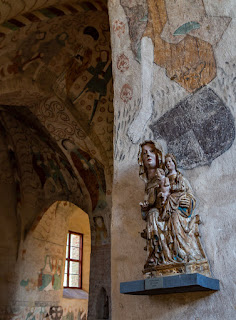
St Anne. Photo Anu Hätinen  The universe does not have to make sense to us. It is not ultimately necessary that we can understand the logic of being. Moreover, being does not ultimately need to have a logic whatsoever. Yet that is what we experience: we encounter the world as something that has a logic, as a series of incidents that make sense, almost without exception. When that is not the case, we shout: "This does not make sense!" And we feel distressed. We stubbornly expect that being makes sense. Obviously, this conviction is right. Our life does not work without a meaning. My words here, these letters on the screen, are designed to convey a meaning. They are written with the intention to be intelligible, not arbitrarily (like this: sodkhg wkreesi lasit). If the reader should find my point flawed, the criterion for that would be the reason, i.e. rationality that we both appeal to.  No one truly believes in the mere chance. On the contrary, it is amazing that the origin o...

Beauty Redeems the World, part 3

Image
Beauty of the cross Cross – the token of Christianity – challenges the aesthetic reading of the Bible. The prophecy of the Good Friday says precisely, that “he had no beauty or majesty to attract us to him, nothing in his appearance that we should desire him…like one from whom men hide their faces he was despised, and we esteemed him not.” (Isaiah 53:2-3) This is the exact opposite of an aesthetic interest! The main artistic problem concerning the image of crucified Christ is that no artist ventures to depict the ugliness of the crucified body as it is (supposing that the image is visible in a church). At the closer scrutiny, the cross of Christ makes the Christian aesthetics possible in its entirety. Without the Son of God who has gone through death and suffering, up to the God-abandonment at the cross, all beauty in the world would be vain entertainment, a deceptive surface that hides the cruel reality. In the end, it is the beauty of our life that gives the ultimate meaning t...

Breaking the pattern: spirituality and abstract paintings by Alvar Gullichsen

Image
  Having no training in visual arts, I hesitate to analyze paintings, modern ones in particular. However, I came across artworks that unpredictably opened a spiritual view that I decided to share in this post. Alvar Gullichsen (b.1961) is a Finnish artist, who has formerly been celebrated for his cartoon-like works (such as Disney-influenced "Posankka") and the imaginary engines of Bonk Factory. Lately, he has been fascinated in geometrical patterns that create a three-dimensional ambiance that seems to surround the beholder.  Gullichsen acknowledges that he surveys mystical philosophy and is interested in spiritual traditions. As a theologian I immediately asked: what kind of spirituality is involved in these abstract paintings? What is the message they convey? The first paintings were technically excellent, they created an illusion of being part of the universe that the painting contained. One felt to be inside a huge, round tube, for instance, Recurrent geometrical pattern...

La Passion de Simone: towards the impossible

Image
  La Passion de Simone (2006) combines two intriguing female figures of the recent century: the Finnish composer Kaija Saariaho (1952-2023) and the French philosopher Simone Weil (1909-1943).   This is a vocal and choral passion in a Bachian vein. The soprano soloist plays the part of the evangelist, as it were, narrating the life story of Simone. The choir comments the incidents, and the speaker (reciting texts by Weil) performs kind of recitatives. The dramatical structure is borrowed from the Stations of the Cross, where Christ's road to Golgotha is viewed as 14 stations. Eventually there are 15 stations in the passion of Simone. Saariaho, together with her librettist Amin Maalouf, portrays Simone Weil as a tragic, if not a pathetic figure. Her life was a failure indeed: Weil, a chronically sick young Jewish philosopher, identified herself with the working class, although never affiliated with a political party. She worked for a time in a factory in 1935, although she ...

Improvisation as a theological method, part 4: Martin Luther and Conclusion.

Image
 Martin Luther: speak more good than true "'You are not to bear false witness against your neighbor.' What is this? Answer: We are to fear and love God, so that we do not tell lies about our neighbors, betray or slander them, or destroy their reputations. Instead we are to come to their defense, speak well of them, and interpret everything they do in the best possible light." To speak well of our neighbors, that is the point of the seventh commandment (or the eighth, according to the Orthodox or Reformed reading). There are several aspects of interest here. To begin with, a good reputation is something invaluable for a person. To lose face has always been a disaster, but never has it been such a threat as in the internet era. To ruin someone's reputation has never been as simple to do as it is today. Once suspicion is leveled (about, say, sexual harassment or economic dishonesty) no explanations will suffice to restore the dignity of the suspected one. Even when t...

Improvisation as a theological method, part 3. Bernard of Clairvaux

Image
  In the history of the Western idea of love,  Bernard of Clairvaux holds a major position. Beside his 85 sermons on the Song of Songs, his treatise On Loving God is of a particular interest. Still today recognizable ideas of romantic love emerged in the 12th century in the songs of troubadours. At the same time, theologians discussed the theme of love, to a certain degree in the same vein. However, Bernard did not consider love as a languishing emotion, it was the view of his antagonist, Abaelard (1079-1142). In Abaelard’s opinion, pure love does not expect its fulfillment. Whoever loves God does not think of anything else, not even one’s own salvation. I love God, without considering whether I find my bliss in him or not. Although this idea has some poetic vigor and it surfaces now and then in the history of mysticism, it has the disadvantage of portraying God as a capricious lover who escapes us and plays with our emotions. Bernard’s approach to love in his On Loving God is...

Improvisation as a theological method, part 2. Gregory the Great.

Image
  An idea pointing towards a liberating understanding of the Scripture is derived from Gregory the Great’s Homilies on Ezekiel: "If someone - looking for virtue - should understand some words of God in a sense contrary to that intended by the one who pronounced them, one speaks words of God, as long as one seeks to build up love (even with another interpretation). For throughout Holy Scripture God speaks to us with one purpose only, to draw us to love of himself and our neighbor."( Hom. in Ez. 1.10.14 ) Love as the hermeneutical principle sounds like a modern, almost liberal point of view. However, Gregory is not saying that it does not matter how one understands the Scripture, as long as one maintains good relationships with other people, or something like that. There is more than that in the love of God and neighbor. For Gregory, reading the Bible is a passionate endeavor. One needs to struggle with the Holy Writ, read it attentively, and pray for deeper understanding. Greg...

Improvisation as a theological method. Towards a free and imaginative reading of the Bible. Part 1

Image
Religious traditions tend to become systems of oppression and attendants of violence. Subjugation of women in religious societies, as well as the difficult position of sexual and gender minorities among churches serve as examples of the violent undercurrents of sacred hierarchies. To say the least, religious convictions are prone to be conservative, unyielding and unimaginative. This should not necessarily be the case. As a matter of fact, religion can be a source of endless creativity and irresistible hope that cherishes all life in its variety. I suppose this applies to all major religions. In this article I however concentrate on the Western Christianity, the religious tradition I am most familiar with. The history of the Western Christendom is full of power conflicts, prejudice and inflexibility, resulting in condemnations and sheer bloodshed. On the other hand, the very same tradition includes innovations, reforms, religious creativity, tolerance,beauty and love of neighbor. My pe...

Deep calleth unto deep

Image
  In a world where everything is public and nothing is hidden, our life becomes void of mystery and eventually meaningless. We lose the sense of depth within our hearts (how pathetic these words sound - and how old-fashioned indeed!) What I tend to say is better expressed by Thomas Merton:  "Actually, our whole life is a mystery of which very little comes to our conscious understanding. But when we accept only what we can conceptually rationalize, our life is actually reduced to the most pitiful limitations, though we may think quite otherwise. We have been brought up with the absurd prejudice that only what we can reduce to a rational and conscious formula is really understood and experienced in our life. When we can say what a thing is, or what we are doing, we think we fully grasp and experience it. In point of fact this verbalization - very often it is nothing more than verbalization - tends to cut us off from genuine experience and to obscure our understanding instead of ...

The Meaning of Life

Image
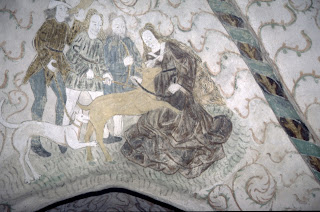
the unicorn  Is it useless to ask for the meaning of life? Or is it arrogant to pretend that one can try to answer that? For many, "The Meaning of Life" suggests hardly more than the Monty Python film in 1983. On the whole, the answers given to the meaning of life are specimens of bird-brained commonsense: "the meaning of life is life itself", "live, laugh, love", "don't worry, be happy".  There are occasions when the search for meaning of life becomes urgent, as when one loses a close friend or a family member, ends up in a divorce, or has serious health issues. In that case it is of no use philosophizing about the perennial question of the meaning of life: "Look, many religions and philosophies have pondered about it, and, ultimately, there is no answer. Go on with your life and try to make the best of it." In an existential situation (as a Tillich or a Kierkegaard would call it) there has to be an answer, or if there is none, it ...

St Augustine's pear theft

Image
 In the second book of his Confessions , St Augustine recounts a boyhood incident: he and his fellows did steal some pears from the neighbourhood. A modern reader probably sneers at the moral pangs Augustine describes in the following chapters. Really, how does one feel guilty on such an occasion? He and other lads wanted to taste some pears from some other's garden. Augustine admits that he was not deeply fond of the pears themselves but rather liked the idea of doing something forbidden: "I joyed in the theft and sin itself." Clearly, it was a heedless act: some teenagers took fruits and threw them away, after hardly tasting them. It happens. Does it yet qualify for an object of serious remorse? Some regard this episode as a proof of the absurdity of Christian ethics, concerned on the minute naughty thoughts. There are true problems in the world, real viciousness takes place, other than folly of the adolescent.  On the other hand, St Augustine's thoughts on human be...

Hamann's "Aesthetica in nuce"

Image
 I feel frightened to enter into discussion on Johann Georg Hamann (1730-88). He is an intriguing figure of the German enlightment and 18th century literature, whom many contemporaries (presumably those who were positively disposed towards him) regarded as an obscure thinker. The less positively disposed thought he has completely lost it. Those who need a magisterial introduction to his theological thinking should consult Oswald Bayer's superb "A Contemporary in dissent" (Eerdmans 2012). I admit that I lack the thoroughness and perspicuity of Bayer's study. Nevertheless, the very boldness of Hamann's writings, his disregard of rules of grammar and philosophy, his appetite for the lowly and contradictory, urge me to read and comment his famous essay "Aesthetica in nuce" (aesthetics in a nutshell). Hamann's texts are a jungle of diverse styles and literary genres where  "exuberant demonstrations of learning" (to employ words of Kenneth Haynes...

"Pietà" by Rainer Maria Rilke

Image
Jesus' sexuality is a difficult issue for Christians. I still remember when I was a young theology student in the late 1980's, at the time of Martin Scorsese's Last Temptation of Christ . Outside the movie theater there were pious believers giving tracts that told that the movie was wrong. What was particularly abhorrent for conservative Christians was the episode where Jesus married Mary Magdalene and raised a family. In the movie it was just a dream of the Christ at the cross, a vision of the life of an ordinary man he could have had. Scorsese, or Nikos Kazantzakis, whose novel the movie was based on, did not claim it to be true. Nevertheless, the very idea of Jesus having sex - or even thinking about it - was enough to raise righteous indignation.  This moral indignation did not appear as theologically wise for the young student. According to the Scripture, Christ was tempted in every way as we are. Does it include sexual temptations? Not necessarily, respond some major ...

More good than true

Image
"You are not to bear false witness against your neighbor." What is this? Answer: We are to fear and love God, so that we do not tell lies about our neighbors, betray or slander them, or destroy their reputations. Instead we are to come to their defense, speak well of them, and interpret everything they do in the best possible light. (Luther: The Small Catechism) To speak well of our neighbors, that is the point of the seventh commandment (or the eighth, according to the Orthodox or Reformed reading). There are several aspects of interest here. To begin with, a good reputation is something invaluable for a person. To lose face has always been a disaster, but never has it been such a threat as in the internet era. To ruin someone's reputation has never been as simple to do as it is today. Once suspicion is leveled (about, say, sexual harassment or economic dishonesty) no explanations will suffice to clear one's honor. Even when the allegation is proved to be entirely ...

Contemplation: Aesthetic and Religious

Image
"Contemplation is the free, more penetrating gaze of a mind, suspended with wonder concerning manifestations of wisdom" ( contemplatio est libera mentis perspicacia in sapientiae spectacula cum admiratione suspensa ) - Richard of St. Victor, Benjamin major, chapter 4.  At the crossroads of art and religion there is contemplation. Basically the verb contemplor means "to view attentively, to survey, to consider." Contemplation is the Latin equivalent of the Greek theoria , that, according to Plato, means the vision of the essential beauty. The essence of beauty surpasses all beautiful objects and actions, and is the source of them all. ( Banquet 211b-e ). Contemplation is not scrutinizing rationality, but rather immediate understanding.  In terms of art and aesthetics, contemplation may be described as a disinterested enjoyment of an artwork. That means that one does not appreciate a work of art because of its price or fame, but simply because it overwhelms oneself an...

A Short History of Beauty: Ancient and Medieval Times

Image
  The Greek word καλός may denote beautiful, good, or useful. That is the case with many other languages, too: the word for beauty has several connotations, other than aesthetic.  In the Greek philosophy, there were also several criteria that make beauty beautiful. The most prominent were order (τάξις ), symmetry, and harmony. In a perfect body, harmony of the human limbs were in accordance with the harmony of the universe, of which the musical harmony was a sounding image.  According to Plato, all visible beauty is originated in the idea of beauty. Diotima's celebrated speech in The Banquet begins with beautiful objects, then discusses beautiful soul and beautiful action, and ultimately presents the idea of beauty behind all this.  Beauty is inseparably connected with the moral goodness and the useful. The vehement criticism of art in Plato's The Republic is principally due to the enormous power of art to move the human soul. Compared to Plato, Aristotle's view on k...